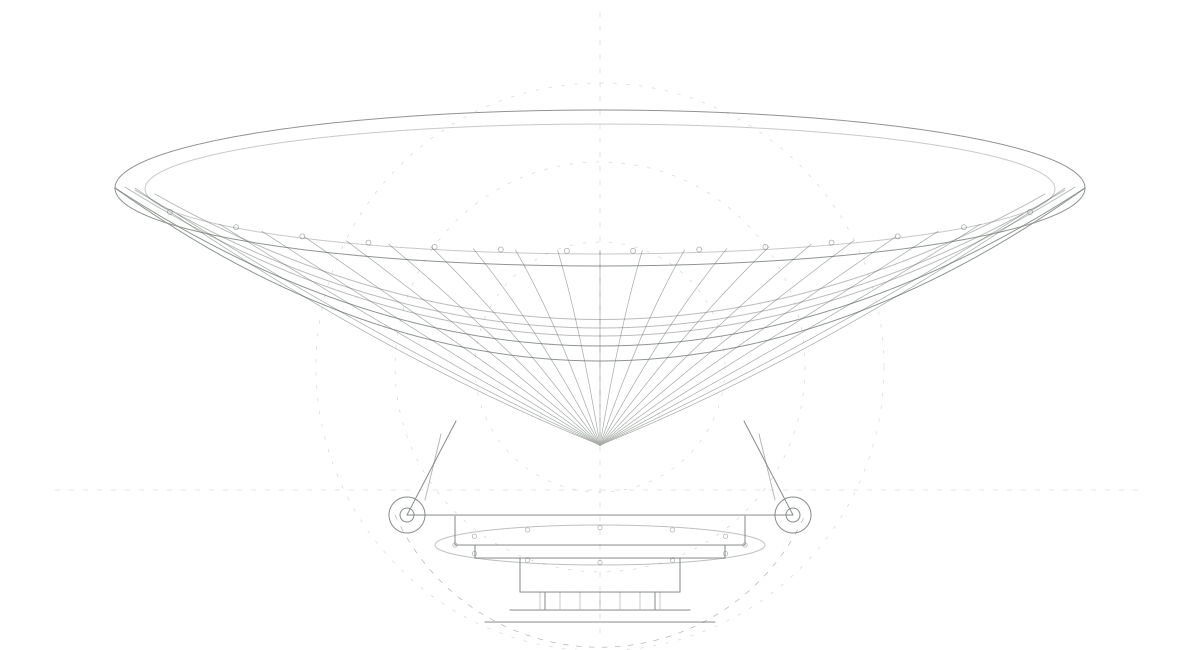
About sixteen years ago, I read a book in which someone described an ancient machine that collected energy from the Moon.
There was another machine for the Sun. Naturally, the two couldn't share a storage room. Their energies were different, and they had to be kept apart.
This was all explained during a hypnosis session conducted by Dolores Cannon, an American hypnotherapist whose subjects apparently recalled previous lives, forgotten civilisations and occasional encounters with extraterrestrials.
Her books weren't particularly well written. I remember thinking that even then. But the stories were difficult to put down.
Especially when they became oddly specific.
The lunar machine, for example, was a huge silver-coloured dish mounted on a rotating pedestal. The solar machine was smaller, metallic and V-shaped. Both had to be carefully positioned to collect their respective energies.
Someone had gone to considerable trouble describing imaginary engineering. Unless, of course, it wasn't imaginary.
That possibility stayed with me.
The mineral
Recently, I remembered reading about archaeologists discovering an unusual chamber in an ancient temple. Its walls, or perhaps the floor, were lined with some peculiar mineral.
I was almost certain the discovery had been made after Cannon's hypnosis sessions.
If that were true, it would be difficult to explain away.
So I asked The Source to help me find the original account.
We located the passage in The Convoluted Universe, Book One. The session had taken place in 1990.
The two machines were there. So were the separate chambers.
Then we found an intriguing archaeological parallel.
At Teotihuacan in Mexico, archaeologists had discovered substantial quantities of mica, including sheets deliberately installed beneath stone floors.
Mica is rather interesting stuff. It splits into thin layers, withstands heat and is an excellent electrical insulator. It can even be used in capacitors.
Why would people transport large quantities of it over considerable distances just to put it beneath a floor?
We spent some time investigating that.
The mineral was associated with important ceremonial buildings and elite compounds. There were possible ritual uses, decorative uses and, naturally, some rather more imaginative theories.
I was enjoying myself.
Then we checked when the mica had been discovered.
Some of it had been documented as early as 1906.
Oh.
There was another problem. Cannon's subject had described a strange mineral processed into sheets, but hadn't actually identified it as mica.
We'd found a resemblance, not a match.
The Moon machine remained an excellent story. Its archaeological confirmation was looking less promising.
The stone lamps
I remembered something else from Cannon's books.
Somewhere in South America, archaeologists had found enormous, almost perfectly round stones. Nobody seemed entirely sure what they were for.
According to one of Cannon's subjects, they were lamps.
Again, wonderfully specific.
And again, The Source found the passage.
The stones were in Costa Rica, which isn't in South America. Close enough for a memory that had been sitting around for sixteen years, I thought.
The stone spheres are real. Hundreds have been documented, ranging from small objects to enormous examples weighing several tonnes.
Their original purpose is still debated.
Cannon's subject described them as lighting devices made from special crystalline materials.
Unfortunately for my investigation, the spheres had been known to archaeologists since the 1940s.
Another mystery explained by a hypnosis session. But not a prediction of a discovery.
I was beginning to notice a pattern.
Still, I had remembered two remarkably obscure details from books I'd read around 2010.
I allowed myself that small victory.
The girl who remembered a song
Then I remembered why I'd eventually stopped reading Cannon.
It was a Finnish study.
Psychiatrist Reima Kampman had investigated people who described previous lives under hypnosis.
One of his subjects was a Finnish schoolgirl who apparently remembered living in medieval England.
During hypnosis, she sang a song in an old form of English.
Now that was interesting. How would a Finnish schoolgirl know a medieval English song?
The song was identified as Sumer Is Icumen In, a genuine medieval composition.
But the investigation eventually connected it to a music-history book the girl had encountered in a library.
She apparently remembered the song without remembering where she'd learned it.
There's a name for this: cryptomnesia.
You retain information but lose track of its source. Years later, it resurfaces, perhaps in a dream or during hypnosis, and feels entirely new.
The girl didn't have to be lying. She could have believed every word of her account.
I found that rather more disturbing than the possibility of reincarnation.
Our memories don't arrive with reliable labels telling us where they came from.
And the confidence with which we remember something tells us surprisingly little about whether it happened.
Back to the machines
We weren't quite finished with the ancient technology.
The Source found descriptions of devices that concentrated sunlight, including some that genuinely existed in antiquity.
Then we encountered Edgar Cayce, the American psychic sometimes called the Sleeping Prophet.
Decades before Cannon's sessions, Cayce had described Atlantean energy technology involving crystals, celestial radiation and specially constructed chambers.
Well, that was interesting.
It didn't prove that Cannon's subject had read Cayce. But it meant the general idea was already circulating long before her session.
We also tried approaching the machines as engineering problems.
A rotating concave dish could collect radiation. A V-shaped structure might concentrate sunlight, depending on its construction.
The trouble was that moonlight contains very little energy compared with direct sunlight. And there was no physical evidence of the machinery, its storage system or anything it supposedly powered.
By this point, the machines were beginning to look less like lost technology and more like a collection of familiar ideas assembled into something new.
And that brought me back to the Finnish schoolgirl.
I wondered how much archaeology, mythology and speculative literature Cannon's subjects might have absorbed without remembering where they'd encountered it.
After the Finnish schoolgirl, that seemed a more promising explanation than ancient lunar engineering.
A rather unreliable narrator
There's something mildly embarrassing about spending an evening investigating whether an ancient civilisation could harvest energy from the Moon, only to discover that the most interesting part of the story concerns your own memory.
I'd remembered the machines remarkably well.
I'd also moved Costa Rica to South America, possibly relocated a mineral-lined floor into a storage chamber, and become convinced that an archaeological discovery had happened later than it actually had.
Not bad for sixteen years, perhaps.
But not exactly evidence I'd want presented in court.
We don't experience our memories as reconstructions. We experience them as memories.
I can still picture things from childhood with extraordinary clarity. The house I grew up in. Particular conversations. People who are no longer around.
How much of that is accurate?
How much has been quietly rewritten every time I've remembered it?
I don't know.
I still find Cannon's stories fascinating. I just have considerably less reason to believe they're accounts of actual previous lives.
Although I admit, the Moon machine would have been cooler.