Website Health Check
Turning a recurring portfolio-management problem into a working website assessment product.
- MY ROLE
- Product owner & specifier
- DEVELOPMENT
- AI-assisted with Claude
- STATE
- Working prototype
- NEXT
- Integration & pilot
A website can be an overlooked acquisition risk.
Serial acquirers inherit a portfolio of websites with different technologies, content standards and digital maturity. Assessing each one manually is slow, difficult to compare and hard to repeat consistently.
There's also a newer question: can AI assistants correctly identify and describe the business, or do they confuse it with another company?
I saw an opportunity to turn individual audits into a repeatable assessment that could support acquisition reviews, integration and ongoing portfolio management.
From customer need to product specification.
I defined the assessment model, report structure and workflows, and directed the development of a web application with Claude as an AI-assisted development tool.
The goal was not another opaque score. It was a report that explains what was checked, what failed, why it matters and what to fix first.
I also reviewed IDX's existing Answer Engine Audit and identified integration considerations, including how page selection can affect the reliability of results.
A scored report, not just a list of issues.
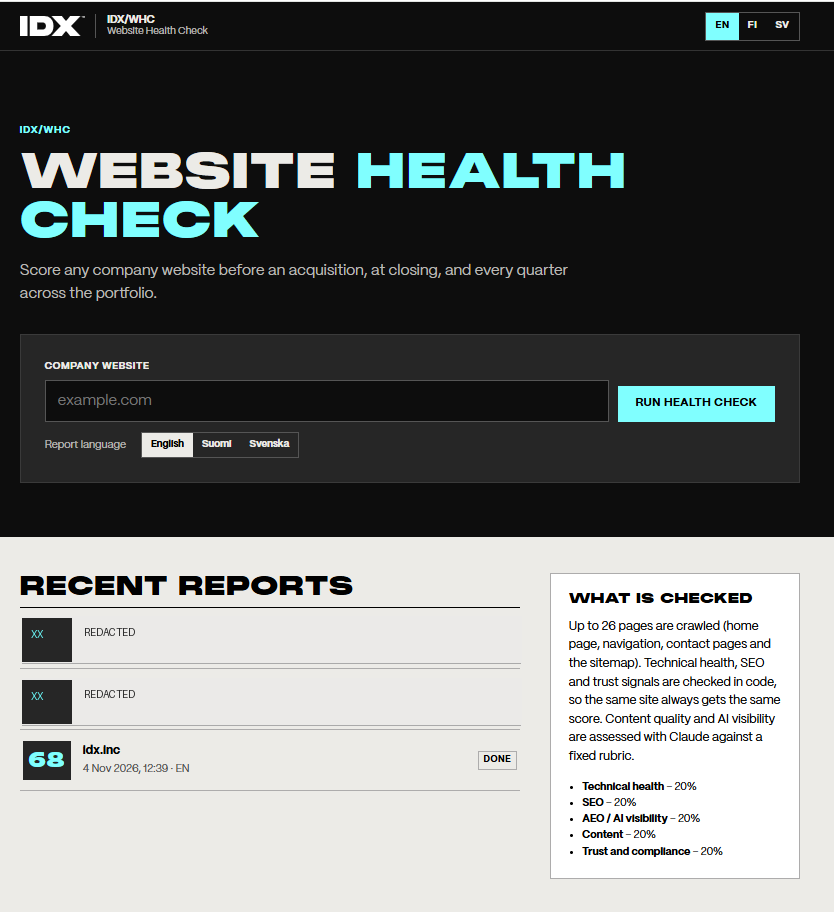
Explainable scoring
Five equally weighted areas: technical health, SEO, AEO / AI visibility, content, and trust and compliance. Point deductions connect to named checks.
Prioritised action
Key findings, top fixes and five priority actions, including affected pages and potential score improvement.
Repeatable technical checks
Code-based checks for technical, SEO and trust signals; rubric-based AI assessments where services are enabled.
Acquisition workflows
Carve-out mode for businesses without an independent website, with digital assets and risk-based next steps.
Nordic-ready reporting
English, Finnish and Swedish reporting, IDX branding and PDF export.
AI identity checks
Designed to test company descriptions and name confusion with fixed questions. Live integration validation is still pending.
What has actually been demonstrated.
In an initial test on a Finnish e-commerce website, the prototype found all six issue types specified in advance: generic titles, a missing description, a truncated description, duplicate category URLs, live placeholder text and missing company identification on the contact page. It also surfaced broken document links that were not on the original checklist.
Measured means measured. Missing means missing.
An example report includes technical, SEO, content and trust scores, individual checks, point deductions and prioritised fixes. Its AI visibility category is explicitly marked “Not measured” because the required integration was unavailable. This is evidence of the report structure, not proof of full AI assessment accuracy.
From functionality to customer value.
Next steps are connecting IDX's existing Answer Engine Audit, testing live AI services, validating performance across more websites and piloting the product with portfolio teams.
Commercial adoption, accuracy across a representative sample and customer outcomes have not yet been established. This case study records the project as it stood in November 2026 and can be updated when pilot evidence becomes available.